
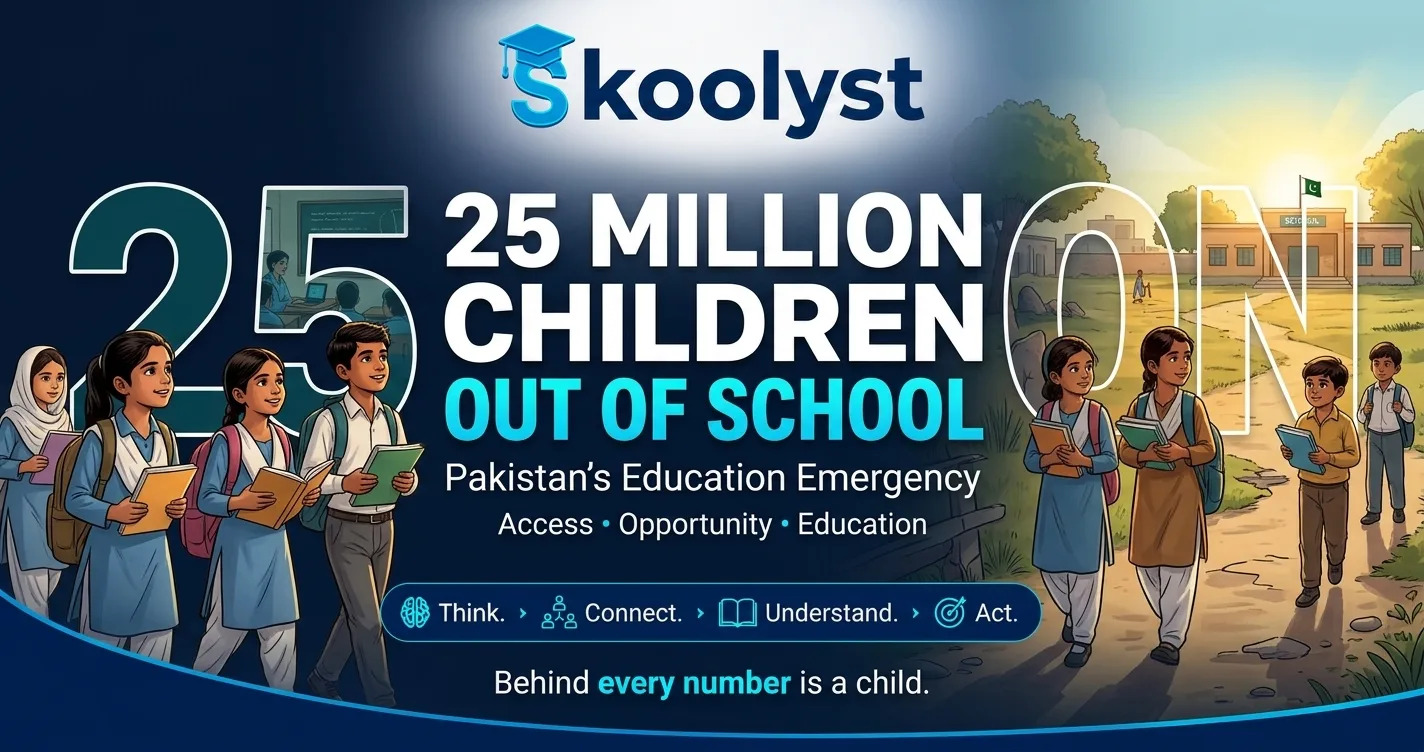

A Number That Represents Real Children, Not Just a Statistic
An estimated 25.1 million children in Pakistan, aged 5 to 16, are currently out of school, according to UNICEF — one of the highest such figures anywhere in the world. It's easy for a number that large to become abstract, a statistic mentioned in passing in a news report or policy document. But behind it are individual children: a girl kept home to help with siblings, a boy in a village with no functioning school nearby, a family that simply can't afford the associated costs of sending a child to class.
Understanding what's actually behind this number — and what's being done about it — matters for anyone who cares about Pakistan's future, not just policymakers and international organizations.
The Scale of the Problem
How the figure is calculated
UNICEF's out-of-school estimate for Pakistan covers children aged 5 to 16 who are not currently enrolled in any form of formal schooling, drawing on national survey and census data combined with international education-monitoring methodology.
How Pakistan compares globally
Pakistan's out-of-school population is among the highest of any country in the world — a scale that places it in the same conversation as countries with far larger total populations, reflecting both Pakistan's large child population and a persistently high proportion of children who never enroll or who drop out early.
Which age groups and regions are most affected
The gap is not evenly distributed — enrollment tends to decline further at higher grade levels (with more children out of school in secondary-age brackets than in early primary), and rural areas generally face steeper access challenges than urban centers, though exact provincial figures should be checked against current, official data before being cited specifically.
Why So Many Children Are Out of School
Poverty and the cost of schooling
Even where public education is nominally free, associated costs — uniforms, books, transport, and the lost income from a child's labor at home or in family work — put schooling out of reach for many of the poorest households.
Distance and access, especially in rural areas
In many rural communities, the nearest functioning school may be a significant distance away, particularly for secondary education, making daily attendance genuinely difficult or unsafe, especially for girls.
Gender gaps and cultural/social barriers
In many communities, girls face additional barriers to school attendance rooted in social expectations, safety concerns on the route to school, and early marriage in some regions — factors that compound the more general access barriers affecting all children.
School infrastructure and teacher availability
Some existing schools lack basic infrastructure — usable classrooms, clean water, functioning toilets — and many struggle with an insufficient number of trained teachers, both of which affect whether families choose to enroll and keep children in school.
Disasters, displacement, and disruption
Natural disasters, including flooding, and displacement due to conflict or economic hardship have repeatedly disrupted schooling for affected communities in recent years, compounding existing access gaps.
The Gender Dimension
Girls' education in Pakistan faces distinct and layered barriers beyond those affecting boys — including household responsibilities, safety concerns during travel to school, and, in some communities, early marriage or a lower prioritization of girls' continued education relative to boys'. These barriers tend to intensify as girls reach secondary-school age, contributing to a widening gender gap in enrollment at higher grade levels. It's worth noting that these patterns vary significantly by region and community, and shouldn't be treated as uniform across the country.
What Happens to Children Who Never Enroll — or Drop Out
Children who miss out on formal schooling face reduced access to future employment opportunities, lower expected lifetime earnings, and, particularly for girls, worse expected health and social outcomes over their lifetimes — consequences that ripple outward to affect families and communities well beyond the individual child.
What's Already Being Done
Government and international programs
Pakistan's federal and provincial governments, often working alongside international organizations including UNESCO and UNICEF, have run various enrollment and retention initiatives, including conditional cash-transfer programs designed to offset the cost of sending children to school.
NGO and community-based initiatives
Numerous local and international NGOs operate community-based schools, particularly in underserved rural areas, aiming to fill gaps where formal government infrastructure doesn't yet reach.
Technology-based approaches, including early AI/edtech pilots
Emerging technology initiatives, including AI-assisted learning tools piloted in some government schools, represent an early and still-developing approach to extending educational access and support — our look at how Pakistan compares to the global AI-in-schools shift covers this angle in more depth.
What Meaningful Progress Would Require
(The following reflects Skoolyst's own analysis, not established policy or reported fact.)
Meaningful, lasting progress likely requires sustained investment across several fronts simultaneously — reducing the real cost of schooling for the poorest families, expanding safe and accessible school infrastructure in underserved areas, addressing the specific barriers facing girls' continued education, and building enough qualified teaching capacity to support increased enrollment. No single intervention addresses a gap this large on its own; the scale of the number reflects the scale of what's genuinely required to close it.
What Individuals Can Actually Do
- Support verified, established organizations working directly on school access and retention in Pakistan, rather than assuming the issue is too large for individual action to matter.
- Support girls' continued education specifically where you're able to, given the additional, compounding barriers girls often face at the secondary level.
- If you're an educator, consider where your skills could support underserved communities, including through community-based or volunteer teaching initiatives — you can also browse verified teacher profiles through Skoolyst Teachers if you're building or growing a teaching career with this kind of impact in mind.
- Stay informed and share accurate information — misinformation or oversimplified statistics about this issue can undermine, rather than support, effective advocacy.
The Bottom Line
Twenty-five million is a number large enough to feel abstract, but every part of it represents an individual child's real, specific circumstances — a family's finances, a community's infrastructure, a girl's particular set of barriers. None of it is inevitable, and progress, while difficult, has happened before: the current 25.1-million estimate is itself down from higher historical figures, evidence that sustained effort does move this number. Skoolyst's mission to connect education is built around exactly this kind of long-term, unglamorous work — connecting students, families, teachers, and resources, in whatever way technology can meaningfully help close a gap this significant.
Frequently Asked Questions
How many children are out of school in Pakistan? An estimated 25.1 million children aged 5 to 16 are currently out of school in Pakistan, according to UNICEF — one of the highest figures of any country in the world.
Why do so many children in Pakistan not attend school? Key factors include poverty and the cost of schooling, distance and access challenges (especially in rural areas), gender-specific barriers affecting girls, inadequate school infrastructure and teacher shortages, and disruption from natural disasters or displacement.
Which province in Pakistan has the most out-of-school children? Enrollment gaps vary significantly by province and by rural versus urban location; readers should consult current, official UNICEF or government data for the most accurate and up-to-date regional breakdown.
Are girls more affected by being out of school in Pakistan? Girls generally face additional barriers beyond those affecting boys, including safety concerns, household responsibilities, and early marriage in some communities, with the gender gap widening at higher, secondary-school grade levels.
What is being done about out-of-school children in Pakistan? Efforts include government and international enrollment programs (including conditional cash transfers), NGO-run community schools in underserved areas, and emerging technology-based initiatives, including early AI-assisted learning pilots in some government schools.
How can technology help address Pakistan's education gap? Technology can extend access to learning resources and teacher support in underserved areas, though it works best as a complement to — not a replacement for — investment in schools, teachers, and basic infrastructure.
Comments (0)
Be the first to comment.
Leave a comment