

A Number Big Enough to Be Hard to Picture
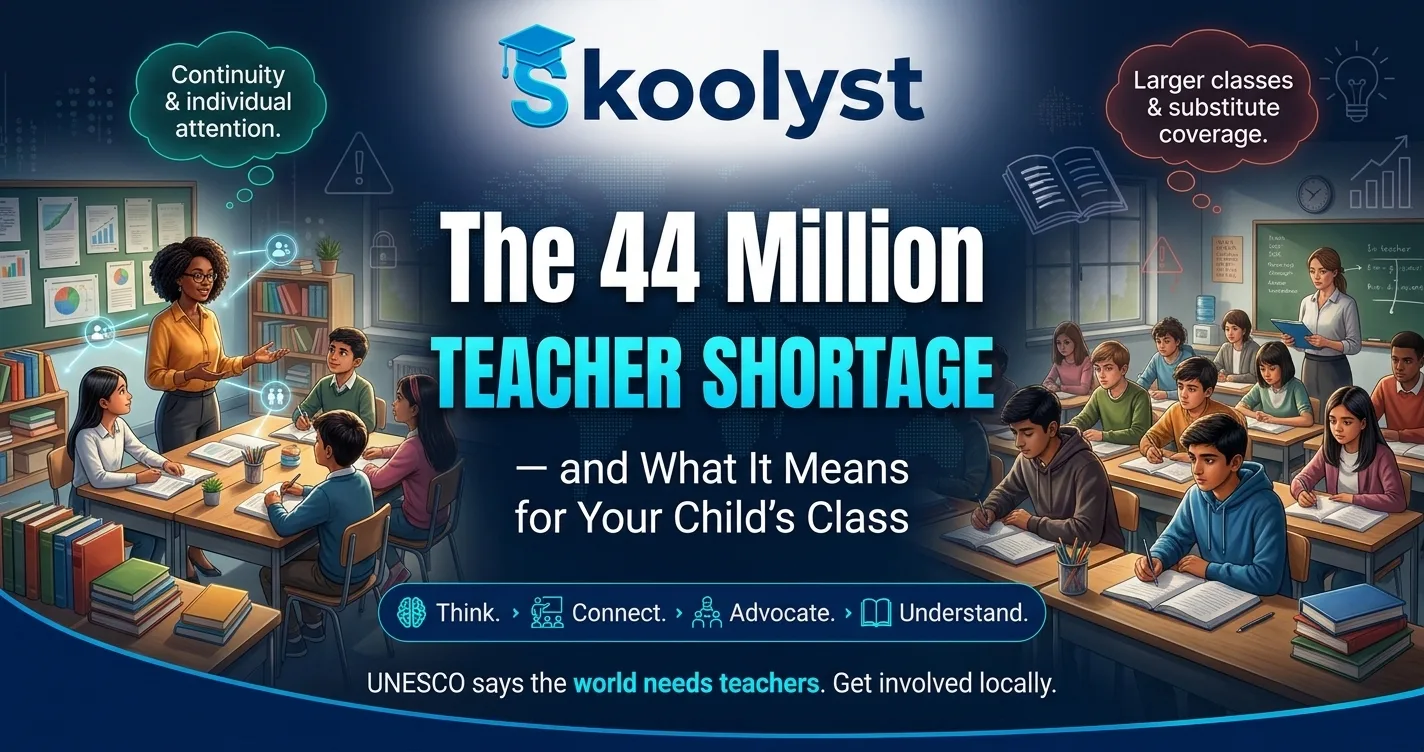
Forty-four million is a hard number to hold in your head. It's roughly the population of a mid-sized country. It's also, according to UNESCO, the number of additional teachers the world needs by 2030 just to make sure every child has access to primary and secondary education.
For most parents, a statistic that large tends to slide past without really landing — it's too big to feel personal. But this particular number has a very direct, very personal translation: it's part of why your child's class might be larger than it used to be, why a favorite teacher left mid-year, or why a substitute has been covering a class for weeks.
Where the 44 Million Figure Comes From
What UNESCO's Global Report on Teachers found
UNESCO, working with the International Task Force on Teachers for Education 2030, published a Global Report on Teachers estimating that 44 million new teachers are needed globally to achieve universal primary and secondary education by 2030.
How this compares to previous estimates
That figure is actually an improvement from an earlier estimate of 69 million teachers needed, calculated back in 2016 — meaning real progress has been made, even as the remaining gap stays enormous.
Which regions are hit hardest
Sub-Saharan Africa carries the largest share of the global shortfall, with an estimated 15 million additional teachers needed in that region alone.
Why the Shortage Is Getting Worse, Not Better
Rising attrition — teachers leaving faster than before
One of the more concerning findings in the report is that primary school teacher attrition — the rate at which teachers leave the profession — has more than doubled, from 4.6% in 2015 to over 9% in 2022.
Why teachers are leaving
While causes vary by country, common threads reported globally include low pay relative to comparable professions, heavy workloads, limited career advancement, and burnout — pressures that intensified during and after the pandemic in many education systems.
Fewer people entering the profession
At the same time attrition has risen, many countries report declining enrollment in teacher training programs, meaning fewer new teachers are entering the pipeline just as more experienced ones are leaving it.
What This Actually Looks Like in a Classroom
Larger class sizes
When there aren't enough teachers, schools often respond by increasing the number of students per class — directly reducing the individual attention any one child receives.
More substitute and underqualified coverage
Shortages frequently mean vacant positions get filled, temporarily or otherwise, by substitute teachers or staff without full subject-matter training, particularly in harder-to-staff subjects like math and science.
Mid-year turnover and lost continuity
A teacher leaving partway through a school year disrupts more than a single class period — it interrupts the relationship and continuity that meaningfully support a child's learning and sense of stability.
What the World Is Doing About It
The Santiago Consensus
In 2025, the World Summit on Teachers, held in Santiago, brought together global education leaders and adopted what's now known as the Santiago Consensus — a set of commitments aimed at reinventing and better supporting the teaching profession worldwide.
What "reinventing the profession" actually means in practice
Broadly, this includes commitments around improving teacher pay and working conditions, strengthening training and professional development, and elevating the status and career pathways of teaching as a profession — long-term structural changes rather than a quick fix.
What This Means for Your Child, Specifically
The 44-million figure is a global estimate, and its effects land very differently depending on where your child goes to school — a well-resourced private school may feel little direct impact, while an under-resourced public school may feel it acutely, in the form of larger classes or more frequent staff turnover. It's worth understanding this as context for what you might be noticing already, not as a prediction that things will necessarily get worse for your specific child. If you're also navigating how technology fits into this picture at home, our guide for parents navigating AI and homework covers a closely related everyday concern.
What Parents Can Actually Do
- Get involved locally. School shortages are often addressed through local advocacy — parent-teacher associations and school boards are frequently where staffing decisions and budget priorities actually get discussed.
- Support the teachers your child already has. Simple, consistent appreciation and communication can meaningfully affect a teacher's sense of being valued — one of the factors linked to whether teachers stay in the profession.
- Use technology to fill genuine gaps, not to replace teachers. Tools like Skoolyst's practice resources can help reinforce learning between classes, particularly useful when class sizes are larger and individual attention is more limited.
- Consider a tutor or mentor for extra support where needed. You can browse verified teacher profiles through Skoolyst Teachers if your child would benefit from additional, individualized instruction alongside their regular classroom.
The Bottom Line
Forty-four million is a global number, but its effects show up in very local, very specific ways — the size of your child's class, whether a favorite teacher stays through the year, how much individual attention is realistically available. Understanding where that number comes from doesn't fix the shortage, but it does make sense of something many parents already feel without quite being able to name. Skoolyst exists to help close some of that gap — connecting families with real, verified teachers and practical learning resources, so that a global shortage doesn't have to mean your own child goes without the support they need.
Frequently Asked Questions
How many teachers does the world need by 2030? According to UNESCO, the world needs an estimated 44 million additional teachers by 2030 to achieve universal primary and secondary education — down from an earlier 2016 estimate of 69 million.
Why is the global teacher shortage getting worse? Rising attrition is a major factor — primary school teacher attrition more than doubled from 4.6% in 2015 to over 9% in 2022 — driven by pay, workload, and burnout pressures, while fewer people are entering teacher training programs.
How does a teacher shortage affect students? Common effects include larger class sizes, more reliance on substitute or underqualified staff, and disruptive mid-year teacher turnover, all of which can reduce individual attention and continuity for students.
What is the Santiago Consensus? It's a set of global commitments adopted at the 2025 World Summit on Teachers in Santiago, aimed at improving teacher pay, working conditions, training, and the overall status of the teaching profession worldwide.
What can parents do about a teacher shortage? Getting involved through local parent-teacher associations, supporting the teachers your child already has, and using supplementary resources like tutoring or practice tools can help address the effects of a shortage at the individual level, even though systemic change requires broader policy action.
Comments (0)
Be the first to comment.
Leave a comment