
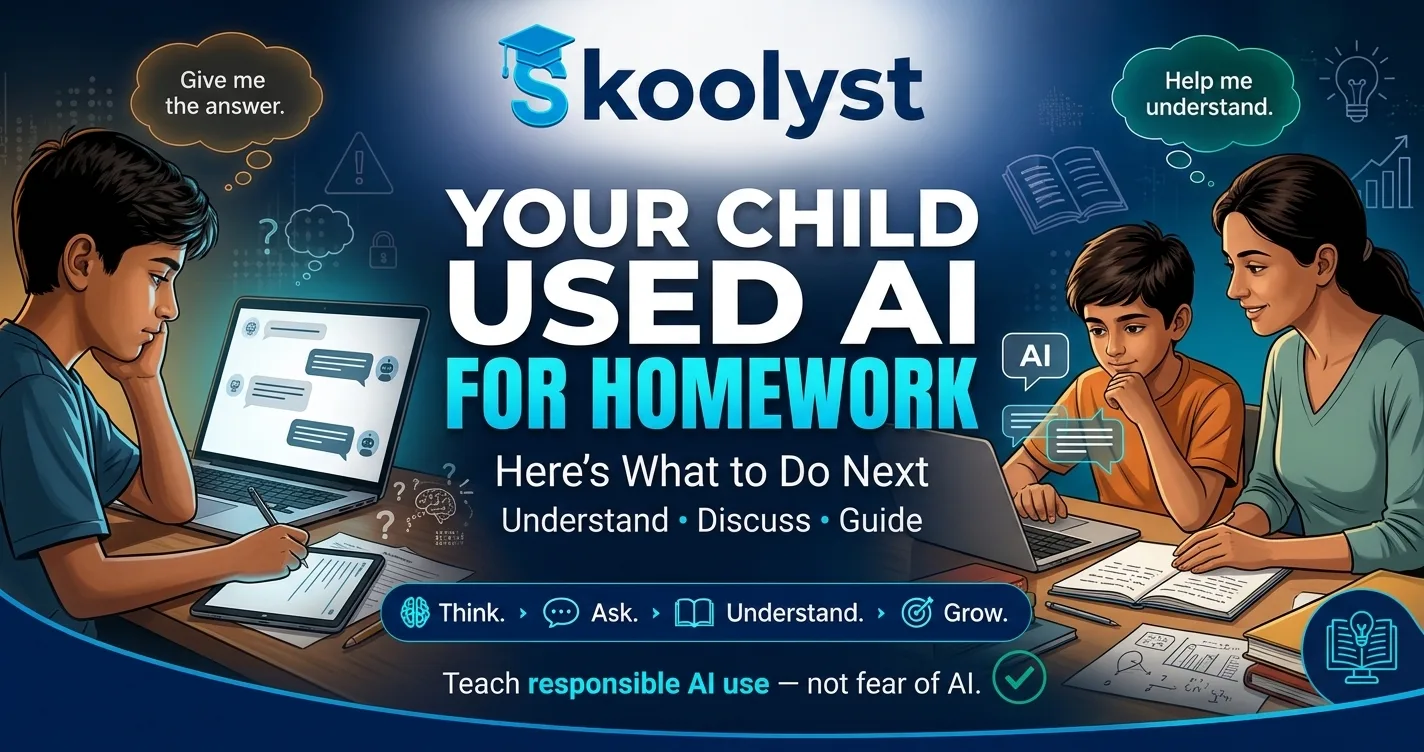

The Moment Every Parent Eventually Faces
You open your child's laptop to help with something else entirely, and there it is — a chat window with an AI tool, mid-conversation about tonight's homework. Or maybe a teacher emails you directly. Or your child just tells you outright, matter-of-factly, the way kids mention things they don't realize are a big deal.
Whatever the moment looks like, the instinct is often the same: a flash of worry, maybe a little anger, and the question of what you're supposed to do about it right now. Here's a calmer way through it.
First: Take a Breath — This Is Normal Now
How common AI homework use actually is
AI tools have become a normal part of how many students approach schoolwork, the same way calculators, search engines, and spell-check became normal before them. Finding out your child has used one isn't a sign that something has gone unusually wrong — it's closer to finding out they used the internet to look something up.
Why panic makes this harder to handle well
A reaction that treats this as a catastrophic betrayal tends to push the behavior underground rather than ending it — your child simply gets better at not telling you, which leaves you with less visibility, not more.
Step 1: Figure Out What Actually Happened
Questions to ask before assuming the worst
Before deciding how to respond, get a clear picture: What was the assignment? What did they actually ask the AI to do? Did they use it to understand something, or to produce a finished answer they then submitted as their own?
The difference between "used AI" and "outsourced the thinking"
There's a real difference between "I was stuck on this math problem and asked AI to explain the steps" and "I asked AI to write my whole essay and I turned it in." Both involve AI. Only one involves your child not doing their own thinking. Get specific before responding — the right next step depends heavily on which of these actually happened.
Step 2: Understand What the Research Says About the Risk
When AI use helps learning
Research on AI tutoring, including the research on AI tutoring effectiveness from a Harvard study comparing AI tutoring to excellent in-person teaching, has found that AI used to explain, question, and check understanding can genuinely accelerate learning — sometimes outperforming very good classroom instruction.
When AI use quietly undermines it
The same body of research also shows a real risk. A study published in PNAS found that students who used AI with no guardrails performed much better during practice but scored significantly worse on a real exam once the tool was taken away — evidence of what researchers describe as a "crutch effect." Related research on cognitive offloading found that leaning on AI to skip mental effort is linked to weaker critical thinking over time, a pattern explored further in what the research says about AI and critical thinking.
Why this matters more than "getting caught"
The real risk to your child isn't a bad grade or a teacher finding out — it's showing up for a test, or a real-world situation, without the underlying skill the AI quietly did on their behalf. That's the outcome worth actually addressing, more than the act of having used the tool at all.
Step 3: Have the Conversation (Without It Becoming a Fight)
What to say
Try something like: "Walk me through how you used this — what did you ask it, and what did you do with what it gave you?" This invites an explanation instead of a defense.
What to avoid saying
Avoid leading with "how could you cheat like this" before you actually know what happened — it forecloses an honest conversation and often isn't even an accurate description of what occurred.
Making it about learning, not punishment
Frame the conversation around whether they actually learned the material, not just whether a rule was broken. "Can you explain this to me now, without the AI?" is often more useful than any punishment, because it tells you — and them — exactly where they stand.
Step 4: Set Clear, Specific Household Rules
Vague rules like "don't use AI for homework" tend to fail because they don't match how homework actually gets done anymore. Specific rules work better:
- AI can be used to explain a concept you're stuck on, but not to write a full answer you'll submit.
- If AI helps you understand something, you should be able to explain it back without the tool open.
- Always check your teacher's specific policy for each assignment — it may differ from one class to another.
- If you're unsure whether a use is allowed, ask before, not after.
Step 5: Check In With the School
Understanding your school's actual AI policy
Policies vary significantly between schools, and even between individual teachers within the same school. Find out what's actually allowed before assuming your household rules and the school's rules match.
Working with teachers instead of around them
A short, non-defensive email to a teacher — "wanted to check in about how AI use is handled for this class" — tends to build trust and gets you clearer, more specific guidance than guessing. You can also browse verified teacher profiles on Skoolyst Teachers if you're looking for outside guidance on how a specific subject or grade level typically handles this.
What Healthy AI Homework Use Actually Looks Like
- Asking AI to explain a concept, then closing the tool and explaining it back in your own words
- Using AI to check a completed draft for clarity or errors, without having it rewrite the work
- Testing your own understanding with practice questions — the kind Skoolyst's practice questions across subjects are built around — rather than only reading AI-generated explanations
- Asking AI "why" something works, not just "what" the answer is
If you want a fuller framework to share with an older child or teenager directly, our full guide to using AI to learn, not cheat walks through the same distinction in language written for students themselves.
When to Be More Concerned
- Your child can't explain or defend work they submitted, even loosely, without the AI tool present
- They've submitted AI-generated text as entirely their own, aware that this violates a stated school policy
- They become notably anxious, secretive, or defensive at any mention of how an assignment was completed
- Grades on unsupervised work are strong, but performance drops sharply on in-class tests or when working without AI access
The Bottom Line
Finding out your child used AI for homework isn't a crisis — it's an opportunity to teach them something more valuable than any single assignment: how to use a powerful tool without letting it think for them. The research is clear that AI can be a genuine asset to learning, and just as clear that it can quietly erode it, depending entirely on how it's used. Your response in this moment — curious rather than accusatory, specific rather than vague — is what actually shapes which direction it goes. Skoolyst's learning resources and access to real, verified teachers exist to support exactly this kind of everyday parenting decision, not to replace your judgment in the moment.
Frequently Asked Questions
What should I do if I catch my child using AI for homework? Start by calmly finding out exactly how they used it — to understand something, or to produce a finished answer — before deciding how serious the situation actually is.
Is it OK for kids to use AI for homework? It depends on how it's used. Using AI to understand a concept or check work is generally considered acceptable; submitting AI-generated work as entirely your own, especially where it violates a school's policy, is not.
How do I know if my child is using AI to cheat? A strong signal is whether they can explain or defend their work without the AI tool present — if they can't, it suggests the thinking happened in the tool rather than in their own head.
What are good rules for AI homework use? Clear, specific rules work best: AI can be used to explain and check understanding, but not to produce a final answer submitted as the student's own, and any use should hold up to being explained back without the tool present.
Should schools ban AI for homework? Most education researchers and policy bodies, including the OECD, favor thoughtful, guided AI use over outright bans, since evidence suggests AI can meaningfully support learning when guardrails and clear expectations are in place.
Comments (0)
Be the first to comment.
Leave a comment