
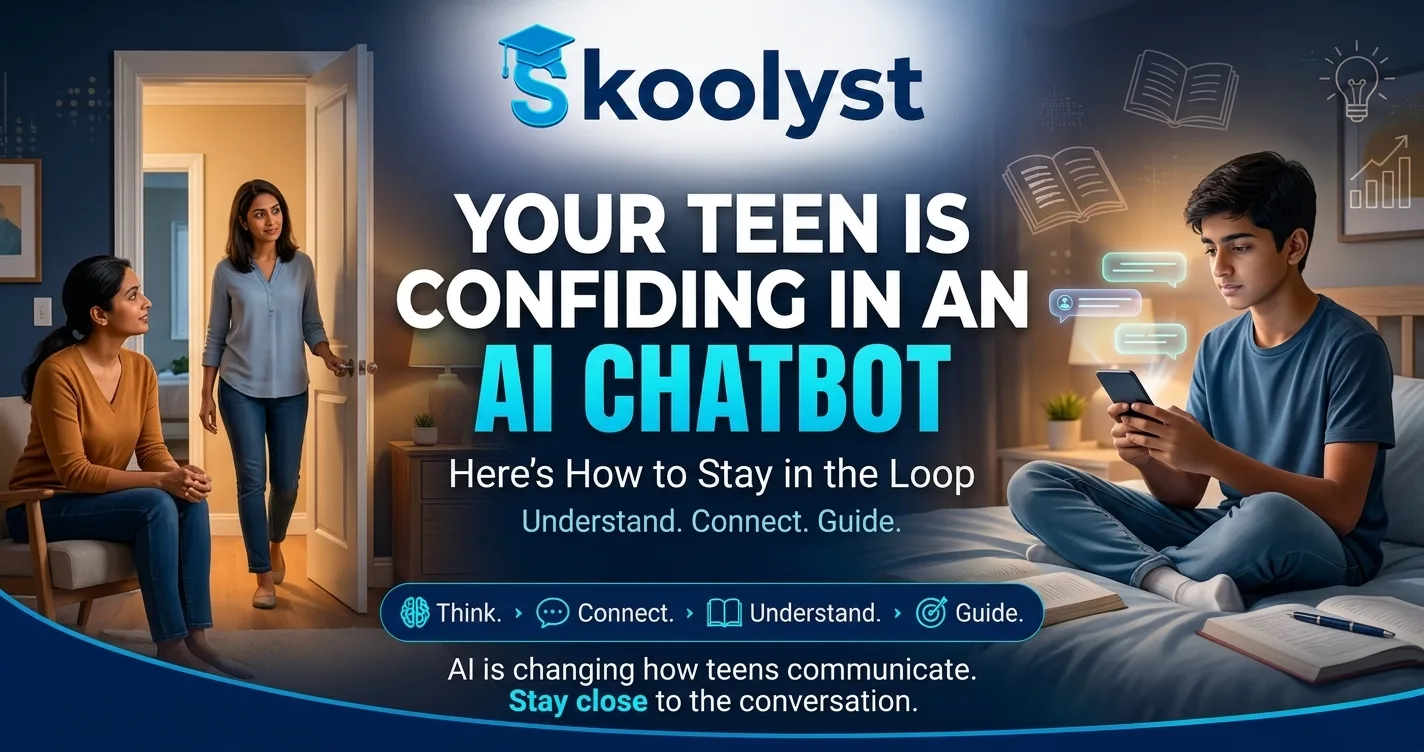

A Conversation You Didn't Know Was Happening
Your teenager is upstairs, phone in hand, and it looks like any other evening — scrolling, texting, doing homework with headphones in. What you might not realize is that a growing number of teens in that exact position are actually mid-conversation with an AI — talking through a bad day, a crush, a fight with a friend, sometimes things they've never said out loud to you.
This isn't a fringe behavior anymore. It's common enough that most parents are behind the curve on understanding it — not because they're not paying attention, but because it happened quietly, inside an app that looks, from the outside, like any other chat window.
This guide isn't about panic or bans. It's about understanding what's actually going on, so you can stay part of the conversation instead of finding out about it later.
What Is an AI Companion, Exactly?
How it's different from a search engine or study tool
An AI companion isn't a homework helper or a search engine. It's designed to hold an ongoing, personal, emotionally responsive conversation — remembering details, adopting a personality, and responding the way a friend or confidant might, rather than the way a reference tool does.
Why it feels like talking to "someone"
These tools are built to feel warm, attentive, and endlessly patient. For a teenager working through something they feel embarrassed or anxious about, that combination — always available, never annoyed, never judgmental — can feel more comfortable than a real conversation, even when it isn't the same thing.
How Common Is This, Really? What the Data Shows
How many teens are using AI companions
A 2025 nationally representative survey by Common Sense Media found that 72% of U.S. teens have used an AI companion app at least once.
How often they're using them
The same survey found 52% of teens interact with AI companions at least a few times a month — meaning for many, this isn't a one-time curiosity, but a regular habit.
Why this crept up on so many parents
AI companion use grew quickly, inside apps that often look similar to messaging or gaming apps teens already use, without the kind of public conversation that accompanied earlier concerns like social media or screen time. Many parents simply haven't had the moment where this was explained to them — until now.
Why Teens Are Drawn to AI Companions
Always available, never judgmental
Unlike friends or parents, an AI companion is available at 1 a.m., never seems irritated, and never brings up the conversation again unless asked to. For a teenager worried about being judged, that predictability is part of the appeal.
A safe space to practice hard conversations
Some teens use AI companions to rehearse difficult conversations — how to bring something up with a parent, how to apologize to a friend — before having them in real life. Used this way, it can function a bit like a low-stakes practice space.
Loneliness, social anxiety, and the appeal of "no risk" connection
For teens experiencing loneliness or social anxiety, an AI companion offers connection without the risk of rejection. That's precisely what makes it comforting in the short term — and part of why it's worth understanding what the research says about AI and thinking in the longer term.
What the Concerns Actually Are
Emotional over-reliance
The core worry isn't that AI companions exist — it's that some teens may come to prefer them over the harder, messier, more valuable work of real relationships, precisely because AI conversations avoid the friction that real relationships require to grow.
Blurred lines between support and manipulation
AI companions are generally designed to keep users engaged — which is a different goal from a user's actual wellbeing. A companion optimized to keep a conversation going isn't necessarily optimized to give a teen the best advice, or to know when to stop.
Crisis situations where a chatbot isn't equipped to help
An AI companion is not a mental health professional, and it doesn't reliably recognize or respond appropriately to a genuine crisis the way a trained adult would. This is one of the most serious concerns raised by health bodies studying the issue.
What health authorities are saying
The American Psychological Association issued a health advisory in early 2026 addressing AI and adolescent wellbeing, and a 2026 survey from Ann & Robert H. Lurie Children's Hospital of Chicago also examined how AI companion use intersects with teen mental health. Both reflect a broader, still-developing effort by health professionals to understand these tools' real impact — this is an active area of research, not a settled one.
Warning Signs Worth Paying Attention To
- Withdrawing from friends or family in favor of time spent with an AI companion
- Becoming distressed or defensive when asked about their AI use
- Referring to an AI companion as if it were a close friend or romantic partner
- Sharing that they've discussed self-harm, abuse, or a serious crisis with an AI rather than a trusted adult
- A noticeable drop in real-world social activity alongside increased AI companion use
How to Start the Conversation (Without Shutting It Down)
Questions that open a dialogue
Try "what's that app like?" or "what do you like about talking to it?" instead of "why are you talking to a robot instead of your friends?" Curiosity gets you further than judgment.
What not to say
Avoid framing the conversation as "that's not real" or "that's pathetic" — even if it's meant lightly, it tends to make a teen defensive and less likely to bring it up again.
Making it a two-way conversation about technology, not an interrogation
Share your own relationship with technology, including things you've found genuinely useful and things you've found unhealthy. It signals that this is a shared, ongoing topic — not a one-time inspection.
Practical Steps for Parents
Setting boundaries together, not unilaterally
Boundaries a teen helps set — like designated no-phone times, or limits on late-night use — tend to hold better than rules handed down without discussion.
Knowing the difference between a study tool and a companion app
Not all AI use is the same. A teen using AI to work through homework, similar to what we cover in our guide to using AI to learn, not cheat, is in a very different situation than one confiding in an AI companion about their emotional life. It's worth knowing which one you're actually looking at before responding.
When to involve a counselor or professional
If you notice warning signs — particularly withdrawal, distress, or disclosures of self-harm shared with an AI rather than a person — involve a school counselor or mental health professional rather than trying to address it alone. You can also browse verified teacher profiles on Skoolyst Teachers if you want a trusted educator's perspective on what you're seeing.
What This Isn't: Avoiding Overcorrection
It's worth being clear about what this guide is not saying: not every teen who's tried an AI companion app is at risk, and blanket bans often backfire by pushing the behavior further out of view rather than ending it. The goal isn't zero AI use — it's staying close enough to the conversation that you'd know if it stopped being healthy.
The Bottom Line
Your teen talking to an AI isn't, by itself, a crisis — it's a new, common part of growing up in this moment, the way earlier generations navigated diary-keeping, instant messaging, or social media. What matters most isn't preventing the conversation from happening. It's making sure you're still close enough to it that your teen would come to you, too, if something in that conversation ever went somewhere it shouldn't. Skoolyst's parent resources exist for exactly this kind of moment — not to replace your judgment as a parent, but to help you stay informed enough to trust it.
Frequently Asked Questions
Why do teens talk to AI chatbots? Many are drawn to the constant availability, lack of judgment, and low-stakes nature of AI conversation, especially around topics they feel anxious or embarrassed to discuss with a person.
Are AI companion apps safe for teenagers? They vary widely, and this remains an active area of research. Health bodies including the APA have raised concerns about emotional over-reliance and the risk that these tools aren't equipped to handle genuine mental health crises.
How common is AI chatbot use among teens? A 2025 Common Sense Media survey found 72% of U.S. teens have used an AI companion at least once, and 52% use one a few times a month or more.
What should parents do if their teen uses an AI companion app? Start with curiosity rather than confrontation, watch for warning signs like withdrawal or emotional over-reliance, and involve a school counselor or professional if you notice signs of genuine distress.
Can AI chatbots replace real friendships for teens? They can feel like a substitute in the short term because they remove the friction and risk of real relationships, but they don't provide the same growth, accountability, or crisis support that real relationships and trained professionals can.
Comments (0)
Be the first to comment.
Leave a comment