
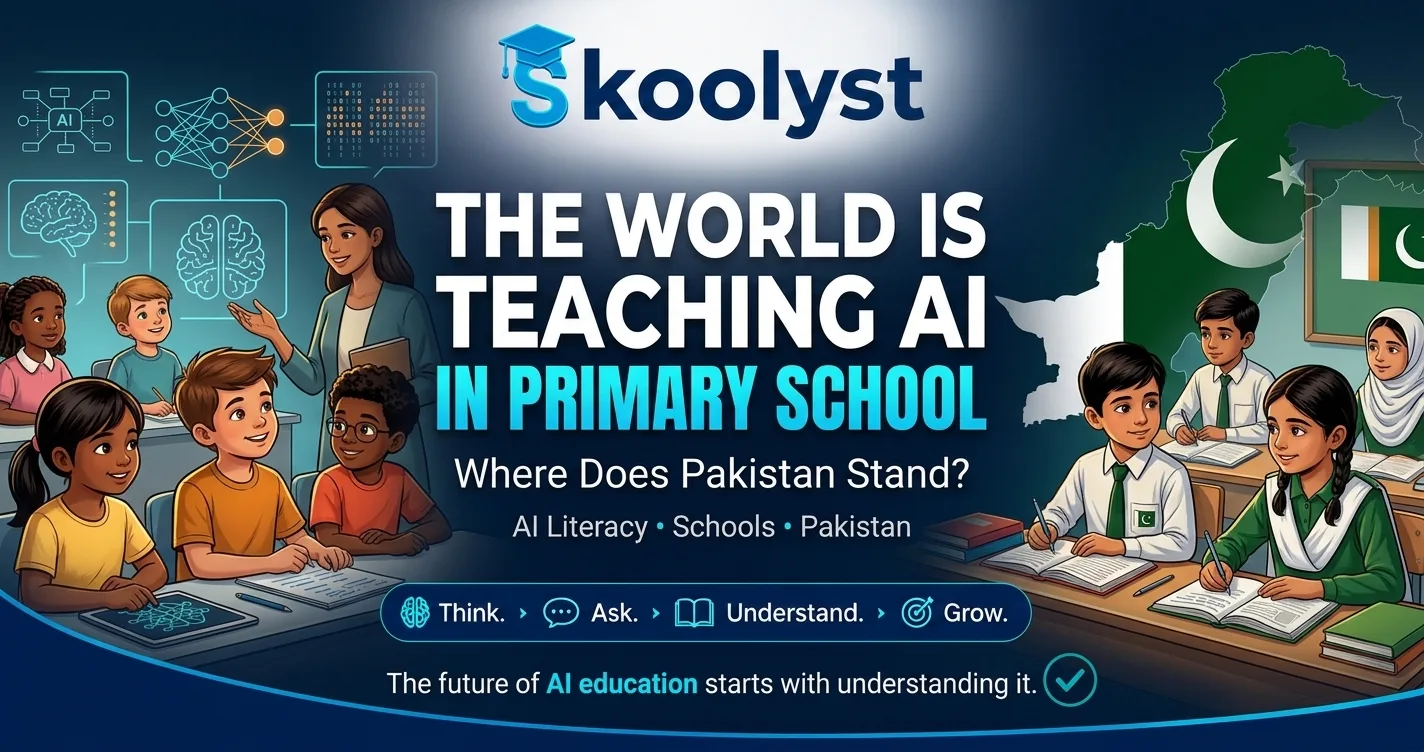

A Global Curriculum Shift, Happening Fast
Somewhere in the world right now, a nine-year-old is sitting through a school lesson about how AI systems make decisions — not as an elective, not as an after-school club, but as a required part of their primary school curriculum. This isn't a pilot program in a handful of wealthy schools. In several countries, it's now official national policy, rolling out at a pace that's easy to miss unless you're looking directly at it.
That raises an obvious question for parents, teachers, and school leaders here: where does Pakistan fit into this picture, and what would "keeping up" even look like given everything else the system is already working to solve?
Who's Already Teaching AI as a School Subject
The UAE's mandatory AI curriculum
The UAE has made AI education a mandatory part of its K-12 curriculum starting in the 2025–26 school year, positioning artificial intelligence literacy alongside subjects like math and science rather than treating it as an optional add-on.
China's nationwide AI education push
China has moved to mandate AI education as part of its national curriculum, reflecting a broader state strategy to build AI fluency starting from an early age, as part of the country's wider AI development ambitions.
India's plan to start AI and computational thinking from Grade 3
India has outlined plans to introduce AI and computational thinking into its curriculum starting from Grade 3, with a rollout beginning in the 2026–27 academic year — a notable move given India's scale and its mix of well-resourced and under-resourced schools.
What "AI Literacy" Actually Means in a Classroom
It's not just coding
AI literacy, as taught in these curricula, isn't primarily about writing code. It's about understanding, at an age-appropriate level, how AI systems work, where they get things wrong, and how to use them responsibly — closer to a mix of digital literacy and critical thinking than to computer science.
Core skills being taught elsewhere
Common elements across these early curricula include recognizing AI-generated content, understanding basic concepts like how AI models are trained on data, and practicing responsible, ethical use — the same foundation covered from a practical angle in what the research shows about AI tutoring, where guided use consistently outperforms unguided use.
Where Pakistan Stands Today
The scale of the access gap
According to UNICEF, an estimated 25.1 million children in Pakistan aged 5 to 16 are out of school — one of the highest such figures in the world. Any conversation about teaching AI literacy has to start from that reality, not around it.
Existing AI/edtech initiatives already underway
Pakistan isn't starting from zero. Khan Academy's Khanmigo AI tutoring tool has been piloted in government schools in Pakistan, and UNESCO has supported AI-related teacher training programs in the country — early, real steps rather than a formal national AI curriculum mandate.
Why this isn't a simple "behind vs. ahead" story
It's tempting to frame this as Pakistan simply lagging behind the UAE or China, but that framing misses the more useful point: countries mandating AI curricula nationally are largely doing so from a position of near-universal school access and reliable connectivity — a starting point Pakistan doesn't yet share. The more honest question isn't "why hasn't Pakistan copied this," but "what would a version of this actually look like here."
The Real Question: What Would AI Literacy Look Like Here?
Low-bandwidth, low-device approaches that still teach AI literacy
AI literacy doesn't require every student to have a personal device or constant internet access. Concepts like recognizing AI-generated misinformation, understanding basic data and bias concepts, and discussing AI ethics can be taught through classroom discussion and printed materials, without requiring 1:1 technology access. Skoolyst's learning resources are built with exactly this kind of accessible, low-bandwidth use in mind.
Why AI literacy and basic access aren't actually competing priorities
There's a temptation to treat "get every child into school" and "teach AI literacy" as competing priorities fighting for the same limited budget. In practice, AI literacy content can often be layered into existing digital-literacy or computer-studies lessons at minimal additional cost — meaning the two goals don't have to be in direct competition the way they're sometimes framed.
What other developing countries are experimenting with
Other developing-country systems are exploring similar layered approaches — treating AI literacy as an extension of existing digital literacy curricula rather than a separate, resource-heavy subject, offering a possible model worth watching as Pakistan considers its own approach.
What Schools, Teachers, and Parents Can Do Now — Without Waiting for Policy
- Teachers can introduce basic AI literacy concepts — like how to evaluate whether content might be AI-generated — within existing digital literacy or computer studies lessons, without needing a new national curriculum to do so.
- Schools can connect with organizations already running AI/edtech pilots in Pakistan, rather than waiting for a formal national mandate before engaging with the topic at all.
- Parents can use our guide to using AI to learn, not cheat to start informal conversations with their children about responsible AI use at home, regardless of what's happening in the classroom.
- School leaders looking to build capacity can browse verified teacher profiles through Skoolyst Teachers to find educators with relevant digital literacy and technology-integration experience.
What Would Meaningful Progress Look Like?
(The following section reflects Skoolyst's own analysis and recommendations, not established policy or reported fact.)
Meaningful progress for Pakistan likely doesn't look like an immediate, top-down national AI curriculum mirroring the UAE's. It more plausibly looks like continued, expanded piloting of AI tools in government schools, layering basic AI literacy into existing digital literacy content rather than creating a new standalone subject, and treating AI literacy and school access as complementary goals within the same broader digital-education push — rather than assuming one must wait for the other.
The Bottom Line
The global shift toward teaching AI in primary school is real, fast-moving, and worth paying attention to — but the right response for Pakistan isn't to copy a UAE-style mandate wholesale. It's to ask what a realistic, accessible version of AI literacy looks like for a system still working to get every child into a classroom in the first place. That's not a lesser ambition — it may well be a more honest and more achievable one. It's also precisely the space Skoolyst exists to work in: connecting schools, teachers, and families to practical tools and resources that meet the system as it actually is, not as we might wish it were.
Frequently Asked Questions
Which countries have made AI a mandatory school subject? The UAE made AI education a mandatory K-12 subject starting in the 2025–26 school year, China has moved to mandate AI education nationally, and India has outlined plans to introduce AI and computational thinking from Grade 3 starting in the 2026–27 academic year.
Does Pakistan have an AI education policy? As of this article's research, Pakistan does not have a formal national AI curriculum mandate comparable to the UAE's, though it has existing AI/edtech pilots, including a Khan Academy Khanmigo rollout in government schools and UNESCO-supported teacher training programs.
What is AI literacy and why does it matter for schools? AI literacy generally refers to understanding how AI systems work, recognizing their limitations and potential for error, and using them responsibly — skills increasingly seen as foundational, similar to broader digital literacy.
How can developing countries teach AI with limited resources? AI literacy concepts can often be integrated into existing digital literacy or computer studies curricula at low cost, using classroom discussion and printed materials rather than requiring universal device access or constant connectivity.
Is Pakistan falling behind on AI education? It depends on the comparison being made. Pakistan hasn't adopted a national AI curriculum mandate like some wealthier, higher-connectivity countries, but it has real, existing AI/edtech initiatives underway, and its more urgent starting-point priority remains expanding basic school access.
Comments (0)
Be the first to comment.
Leave a comment