

The 2 a.m. Question Every Student Faces
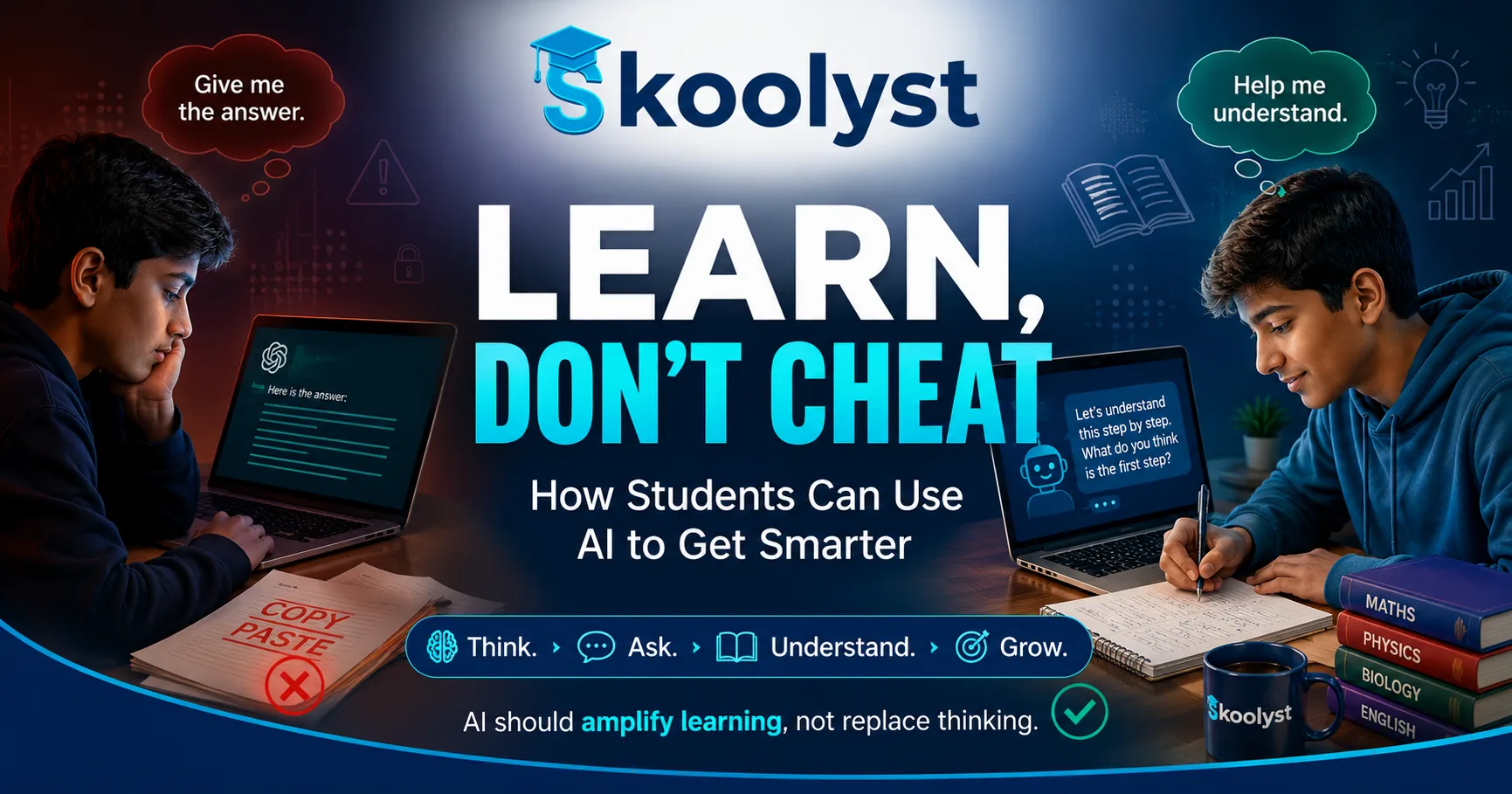
It's late. The assignment is due in the morning. The cursor blinks in a chat window, and one question sits between you and a finished page: do I ask AI to do this for me, or do I ask AI to help me do it myself?
Every student who has opened ChatGPT, Gemini, or any other AI tool while doing homework has faced some version of this moment — even if they didn't think of it that way. It feels like one choice. It's actually two very different paths, and they lead to very different places by exam time.
This guide is not here to tell you AI is bad, or to pretend it isn't already part of how you study. It's here to show you — with real research, not guesses — how to use it in the way that actually makes you smarter, and how to avoid the way that quietly doesn't.
"Cheating" vs. "Learning" — The Line Most Students Don't See
Two ways to ask AI the same question
Imagine two students with the same essay assignment on climate change.
Student A types: "Write me a 500-word essay on causes of climate change." They copy the result, tweak a few words, and submit it.
Student B types: "I think the main causes of climate change are fossil fuels and deforestation — can you push back on my argument and point out what I'm missing?" They read the response, argue back, and then write their own essay incorporating what they learned.
Both students "used AI." Only one of them learned anything. The tool was identical. The outcome wasn't.
Why the difference matters more than the rules
Most school AI policies focus on whether you used AI. That's the wrong question to build your own habits around. The more useful question — the one this guide focuses on — is what did the AI do for you: did it think so you didn't have to, or did it help you think better than you would have alone?
What the Research Actually Shows About AI and Learning
This isn't a matter of opinion. In the past two years, researchers have run real experiments — not surveys, actual randomized studies — to find out what AI does to learning. The results are more interesting, and more useful, than either the hype or the panic you've probably seen online.
The Harvard study: AI tutoring beat a great classroom
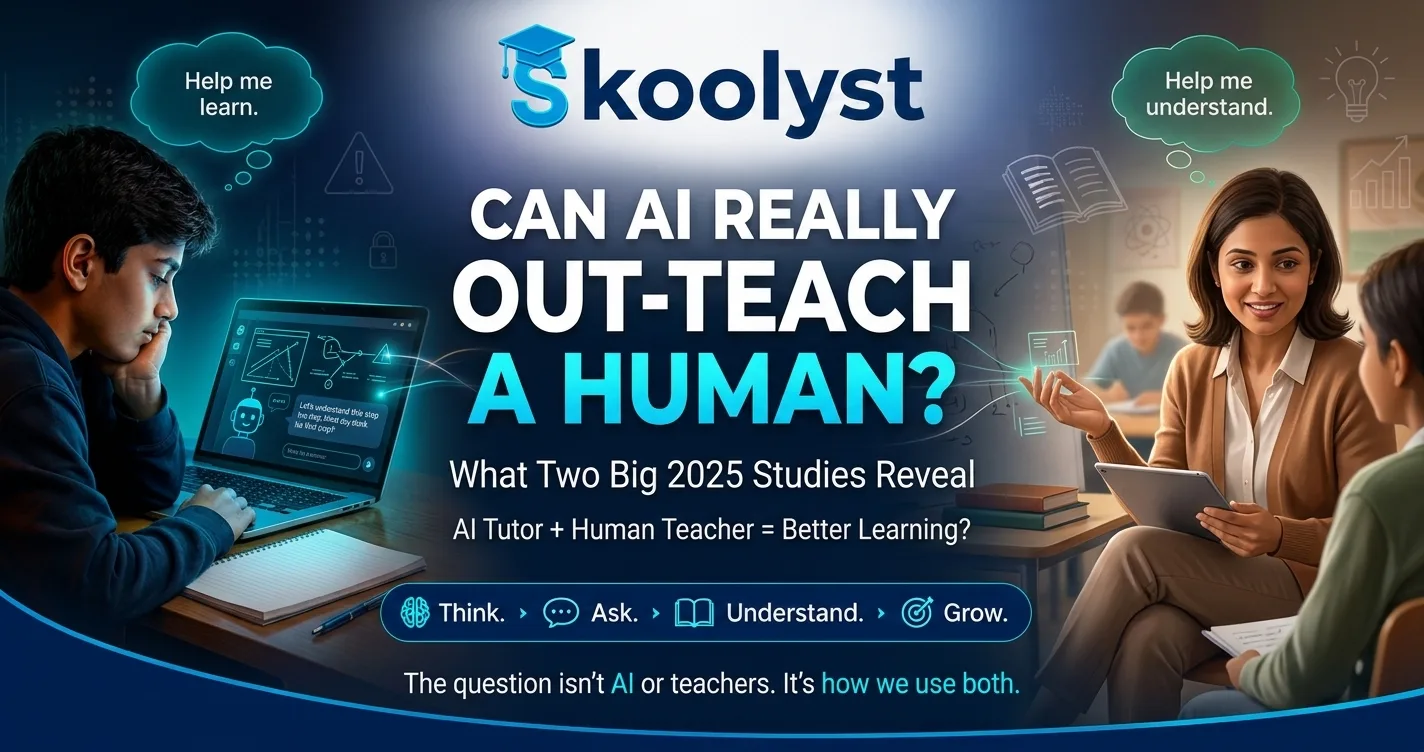
Researchers at Harvard ran a study with 194 undergraduate physics students, comparing an AI tutor against an in-person, highly interactive "active learning" class — widely considered one of the best teaching methods available. The result: students using the AI tutor learned significantly more in less time than the students in the excellent in-person class.
That's a real, peer-reviewed finding, published in Scientific Reports. It's a strong case for AI as a learning tool — under the right conditions.
The PNAS study: unguarded AI use backfired at exam time
Here's the catch. A separate study, published in the journal PNAS, gave nearly 1,000 high school students in Turkey access to AI while practicing math problems. One group had access to a plain AI chatbot with no restrictions. Another had access to an AI "tutor" designed with learning guardrails — one that nudged them toward understanding instead of just giving answers.
During practice, the unrestricted AI group looked like geniuses — they did far better on practice problems. But once the AI was taken away and they sat a real exam, that same group scored worse than students who'd had no AI at all. The researchers described the unrestricted AI as functioning like a crutch: it made the practice easier without making the students any stronger.
The guardrailed AI tutor group, by contrast, held onto — and built on — their gains.
The "cognitive debt" question — are we losing the ability to think?
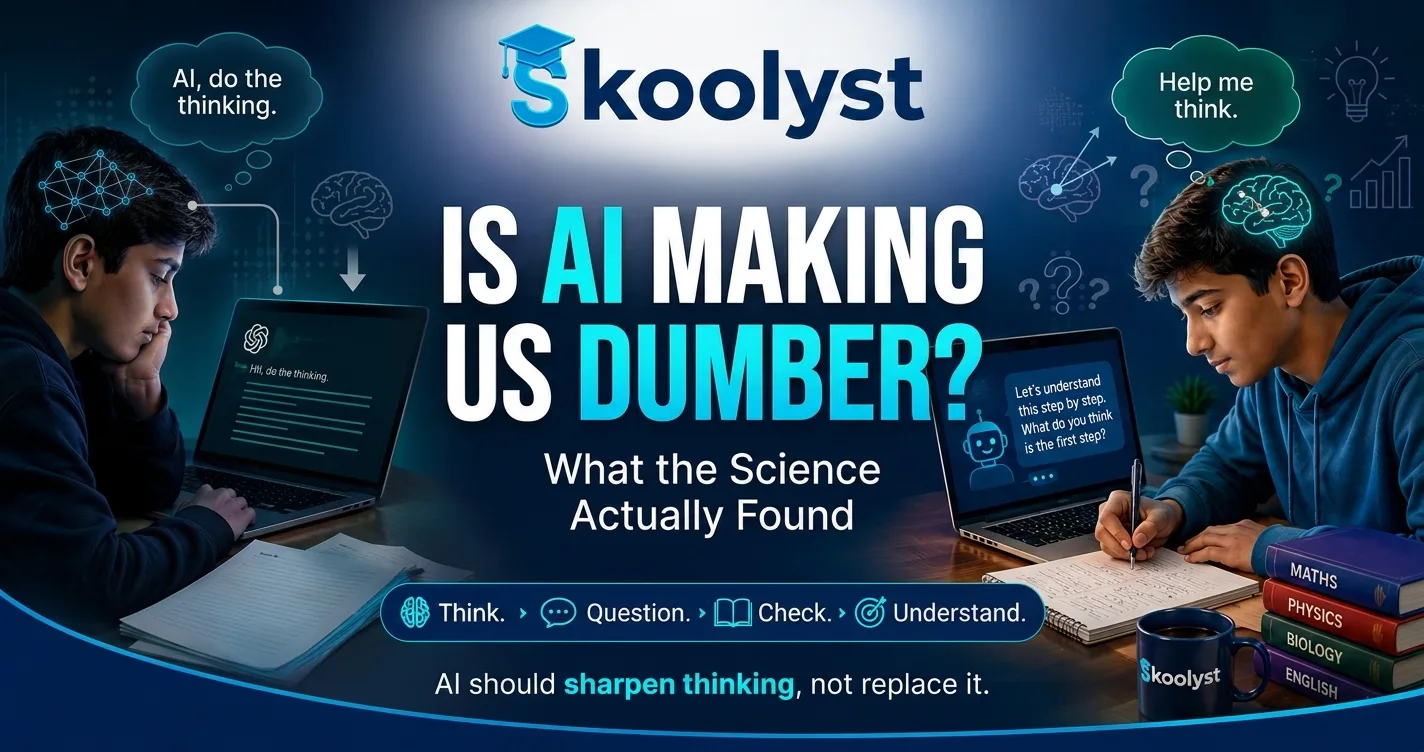
A widely discussed MIT Media Lab study used brain-scanning equipment (EEG) to compare people writing essays with AI help versus without. It found that people who relied on AI showed weaker brain connectivity patterns associated with focused thinking. The researchers called this "cognitive debt."
It's worth being honest about the limits of this one: it's a preprint, meaning it hasn't yet gone through full peer review, and the sample size was small (54 people, with only 18 completing every stage). It's a signal worth paying attention to, not a verdict.
A separate, peer-reviewed study of 666 adults in the UK, published in the journal Societies, found a similar pattern in real-world habits: people who leaned on AI more heavily tended to score lower on critical thinking measures — especially younger users — and the effect seemed to run through something researchers call "cognitive offloading," letting a tool do mental work you'd otherwise do yourself.
What this means in plain terms
Put together, these studies point to one consistent idea: AI can make you a stronger learner, or a weaker one — and the difference is how you use it, not whether you use it. Used to challenge, quiz, and explain, it can outperform even excellent traditional teaching. Used to skip the hard part, it can leave you looking capable right up until the moment you're tested without it.
The Student's Playbook: 5 Ways to Use AI That Build Understanding
- Ask it to quiz you, not answer for you. Instead of "explain photosynthesis," try "quiz me on photosynthesis and tell me what I got wrong." You browse practice questions across subjects the same way — testing yourself, not reading answers.
- Ask it to critique your draft, not write it. Write your own first attempt — even a rough one — then ask AI what's weak, unclear, or missing. You keep authorship; AI becomes an editor, not a ghostwriter.
- Ask "why," not just "what." "What's the formula" gets you an answer you'll forget by Friday. "Why does this formula work" gets you understanding you can rebuild from scratch on exam day.
- Use it to explain what confused you in class. This is where AI genuinely shines — as a patient, always-available tutor for the one concept your teacher moved past too quickly.
- Explain it back. After AI explains something, close the chat and explain the idea out loud in your own words, to yourself or a friend. If you can't, you haven't learned it yet — you've just read it.
The Parent's Playbook: Supporting Without Policing
Questions to ask instead of "did you use AI?"
Try "what did you learn doing this?" or "can you explain the main idea to me?" instead. These questions reveal understanding regardless of what tools were involved — and they open a conversation instead of shutting one down.
Spotting the difference between help and outsourcing
A student using AI well can usually explain their work without it in front of them. A student who's outsourced the thinking often can't — and that gap, not the tool itself, is the real warning sign.
Talking about AI use honestly, without shame
Most students are already using AI, whether or not parents realize it. Treating it as a forbidden secret tends to push it underground; treating it as a skill to use well tends to bring it into the open, where you can actually guide it.
The Teacher's Playbook: Designing Work AI Can't Shortcut
Process-based assignments and drafts
Grading the outline, the first draft, and the final piece — not just the finished product — makes it far harder for a student to submit AI-generated work as their own, and far easier to see genuine growth.
Short oral check-ins
A two-minute conversation about why a student made a specific choice in their work reveals understanding (or its absence) faster than almost any written assignment can.
Setting clear, written AI-use expectations
Vague rules produce vague compliance. Specific, assignment-by-assignment guidance — "AI allowed for brainstorming, not for final drafting," for example — gives students a real standard to meet instead of a rule to guess at.
Where Is the Line? What Counts as Cheating
As a general rule of thumb:
- Likely fine: using AI to explain a concept, quiz yourself, brainstorm ideas, check grammar, or get feedback on your own draft.
- Likely not fine: submitting AI-generated text, code, or answers as your own original work without disclosure, when your school's policy requires original work.
- When in doubt: ask your teacher directly, and default to disclosing AI use rather than hiding it. A conversation about how you used a tool is almost always better than being caught not mentioning it.
Using AI When Data and Devices Are Limited
Free tiers and low-data tools
Most major AI tools offer functional free tiers that work over slow connections in text mode; disabling image generation and unnecessary extensions can meaningfully cut data use during a study session.
Offline-friendly study habits
Batch your questions before you go online — write down everything you're confused about during the week, then use a single, focused AI session to work through all of it at once, rather than relying on constant live access.
The Bottom Line
AI hasn't changed what learning actually requires — effort, struggle, and the willingness to be wrong before you're right. What it's changed is how easy it's become to skip that struggle without anyone immediately noticing, including you. The research is consistent: used to challenge yourself, AI is one of the most powerful learning tools available. Used to avoid the challenge, it's an expensive way to feel prepared for a test you're not actually ready for.
If you want to put this into practice, Skoolyst's learning resources let you test your own understanding across subjects, and Skoolyst Teachers connects you with real educators when you need more than a chatbot can give you. Because at the end of the day, Skoolyst's role isn't to replace your teacher, your parents, or your own thinking — it's to connect all three, a little more effectively.
Frequently Asked Questions
Is it cheating to use ChatGPT for homework? It depends on how it's used and what your school's policy says. Using AI to brainstorm, get feedback, or check your understanding is generally considered acceptable; submitting AI-written work as entirely your own, without disclosure, is generally not.
Does using AI make you worse at thinking? Research suggests it can, if you use it to avoid mental effort rather than support it — a pattern researchers call cognitive offloading. Used to challenge yourself rather than replace effort, evidence points the other way.
Can AI tutors replace teachers? A 2025 Harvard study found AI tutoring outperformed an excellent in-person class on learning outcomes — but that same research relied on well-designed AI systems and doesn't address the mentorship, motivation, and relationship-building teachers provide beyond content delivery.
How can students use AI without losing learning? Use it to quiz yourself, critique drafts you've already written, and explain confusing concepts — rather than to generate finished work you submit as your own.
How should parents monitor AI homework use? Focus conversations on whether your child can explain their work in their own words, rather than policing whether AI was used at all.
Comments (0)
Be the first to comment.
Leave a comment