
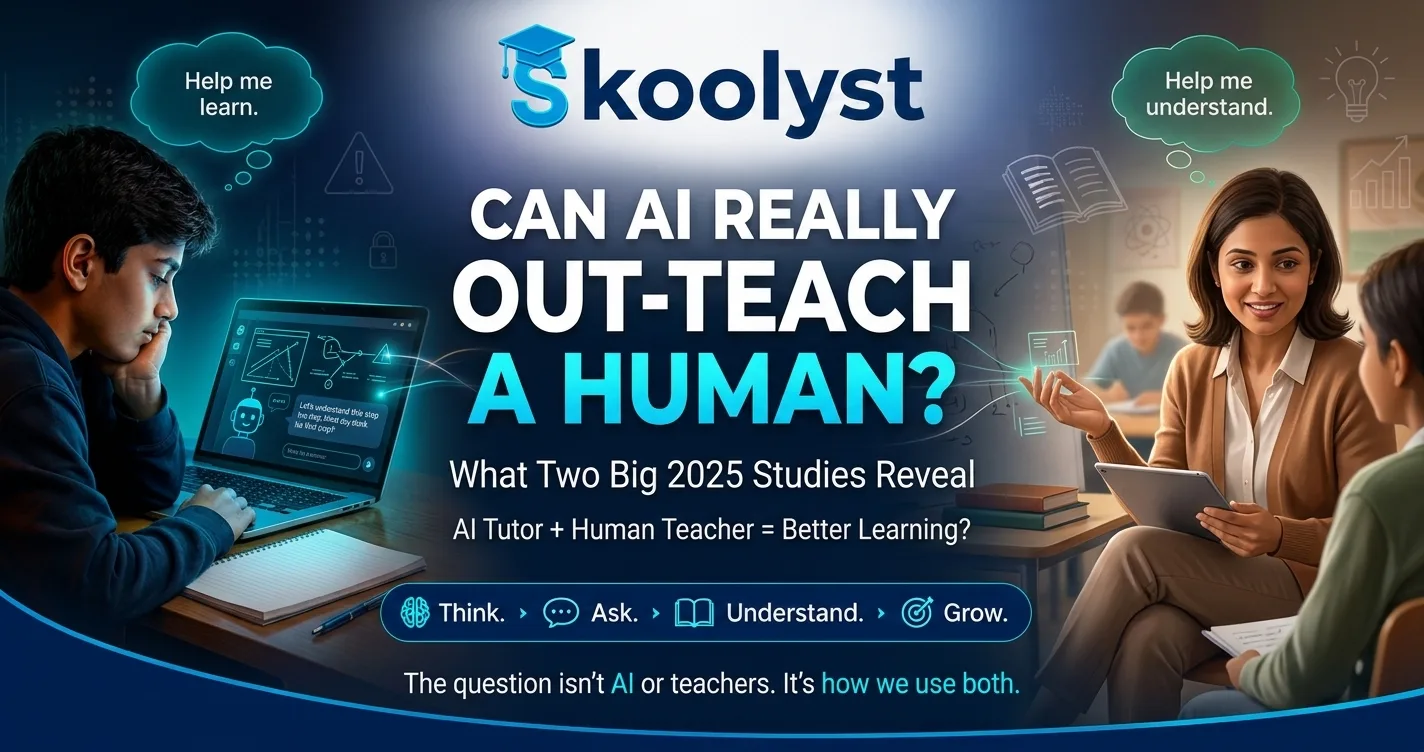

A Question That Sounds Simple But Isn't
Ask "can AI replace teachers?" and you'll get two confident answers, depending on who you ask — one insisting AI tutors are already better than human teachers, the other insisting a chatbot could never replace a real classroom. Both answers are oversimplified, and both misuse the same body of research to make their point.
Two rigorous studies published in 2025 looked directly at AI tutoring effectiveness. One found AI outperformed excellent in-person teaching. The other found the same kind of tool left students measurably worse off. Understanding why both are true is far more useful than picking a side.
Study One: AI Tutoring Beat an Excellent Classroom
How the Harvard study was designed
Researchers at Harvard studied 194 undergraduate physics students, comparing two groups: one using a purpose-built AI tutor, and one attending an in-person "active learning" class — a teaching method built around student participation and interaction, widely regarded as one of the most effective approaches available, not a passive lecture.
What it found
Students working with the AI tutor learned significantly more, in significantly less time, than students in the active-learning classroom — a genuinely striking result, given that active learning was already considered a gold standard.
Why this result surprised even the researchers
The comparison wasn't AI versus a weak teaching method — it was AI versus one of the best-evidenced classroom approaches available. That the AI tutor still came out ahead is a meaningful finding, not just a predictable one.
Study Two: The Same Tool Made Students Worse Off
How the PNAS study was designed
A separate study, published in PNAS, gave nearly 1,000 high school students in Turkey access to AI while practicing math problems. One group used an unrestricted AI chatbot; another used a version specifically designed with learning guardrails, built to prompt understanding rather than hand over finished answers.
What it found
During practice sessions, the unrestricted AI group performed dramatically better — about 48% better than the control group. But once the AI was removed and students sat a real exam, that same group scored roughly 17% worse than students who'd had no AI access at all.
The "crutch effect" — why practice scores went up but exam scores went down
The unrestricted AI group hadn't actually built the underlying skill — they'd built a habit of getting answers from a tool. Take the tool away, and the appearance of competence disappeared with it. The guardrailed group, by contrast, held on to real gains, because the tool was designed to build understanding rather than substitute for it.
Wait — Don't These Two Studies Contradict Each Other?
They tested different things
The Harvard study measured how much students learned while using a well-designed AI tutor. The PNAS study measured how much of that learning actually stuck once the tool was taken away — and specifically tested what happens when the tool has no guardrails at all.
The design of the AI tool mattered more than the presence of AI itself
Both studies are really telling us the same underlying story from two different angles: AI can be an extraordinarily effective teaching tool, or an expensive way to fake competence, depending entirely on how it's built and used — not on whether it's used at all.
Guardrails vs. no guardrails — the real variable
The PNAS study's guardrailed "tutor" condition — designed to nudge students toward understanding rather than hand over answers — performed far better than its unrestricted counterpart. That single design choice, more than anything else, separated the tool that helped from the tool that hurt.
So What Actually Makes AI Tutoring Work?
Taken together, these two studies point to a handful of concrete principles: tools that ask questions before giving answers outperform tools that simply solve the problem; tools designed around a specific curriculum and pedagogy (as in the Harvard study) outperform generic, open-ended chat; and testing understanding without the tool present — the way the PNAS researchers did — is the only reliable way to know if real learning happened, rather than temporary, tool-assisted performance. If you want a closer look at applying this distinction as a student, our guide to using AI to learn, not cheat walks through exactly this kind of AI use in practice.
What Neither Study Measured — The Parts of Teaching AI Doesn't Touch
Mentorship and relationship
Neither study measured whether an AI tutor can build the kind of trusting relationship that helps a struggling student stay engaged over months or years — something human teachers do as a matter of course.
Motivation and encouragement
Test scores don't capture whether a student felt believed in, noticed, or encouraged to keep going after a bad week — dimensions of teaching that matter enormously but weren't part of either study's design.
Classroom management and social-emotional learning
Running a classroom of 30 teenagers, managing conflict, and supporting social-emotional development are core parts of a teacher's job that an AI tutoring study, by design, never tests.
What This Means for Schools Choosing AI Tools
Questions to ask before adopting an AI tutor
Does the tool ask questions and prompt reasoning, or does it hand over finished answers? Was it evaluated on learning that lasts after the tool is removed, or only on performance while using it? Is it designed around a specific curriculum, or is it a generic chatbot repurposed for tutoring? Browsing verified teacher profiles through Skoolyst Teachers is one way schools and families can pair any AI tool with real instructional expertise, rather than choosing one or the other.
Red flags to watch for
Be cautious of tools marketed primarily on how quickly students complete practice problems, rather than how well students perform once the tool is taken away — the PNAS study suggests that gap is exactly where the real risk hides.
What This Means for Parents and Students
The practical takeaway isn't "AI tutoring is great" or "AI tutoring is dangerous" — it's that the same technology can produce either outcome, and the deciding factor is design and use, not the technology itself. Students can build good habits around this by using Skoolyst's learning resources to test genuine understanding, the same way the PNAS researchers tested it — without the tool present. It's also worth reading what the research says about AI and critical thinking, since the same crutch effect shows up there too.
The Bottom Line
The honest answer to "can AI out-teach a human?" is: sometimes, under specific conditions, for specific kinds of learning — and just as easily, it can quietly undermine the very learning it appears to support. The difference isn't a mystery; it's a design choice, visible in exactly the gap between these two studies. What both studies agree on, even in disagreement, is that thoughtful design and real instructional expertise still matter enormously — which is precisely the balance Skoolyst is built around: technology that connects to real teachers and real learning, rather than replacing either.
Frequently Asked Questions
Can AI tutors replace human teachers? Research shows AI tutoring can outperform even excellent classroom instruction in controlled study conditions, but neither major 2025 study measured mentorship, motivation, or classroom management — core parts of teaching that AI hasn't been shown to replace.
What did the Harvard AI tutoring study find? It found that undergraduate physics students using a well-designed AI tutor learned significantly more, in less time, than students in an excellent in-person active-learning class.
Is AI tutoring effective for students? It can be highly effective when the tool is designed to prompt reasoning and understanding — but research also shows it can actively harm exam performance when it simply hands over answers without guardrails.
Why did AI tutoring backfire in the PNAS study? Students using an unrestricted AI chatbot performed much better during practice but scored worse on a real exam once the tool was removed, suggesting they had learned to rely on the tool rather than building the underlying skill.
Should schools use AI tutors instead of teachers? The evidence doesn't support an either/or choice. The strongest outcomes come from thoughtfully designed AI tools used alongside skilled teachers, not from AI replacing teachers entirely.
Comments (0)
Be the first to comment.
Leave a comment