
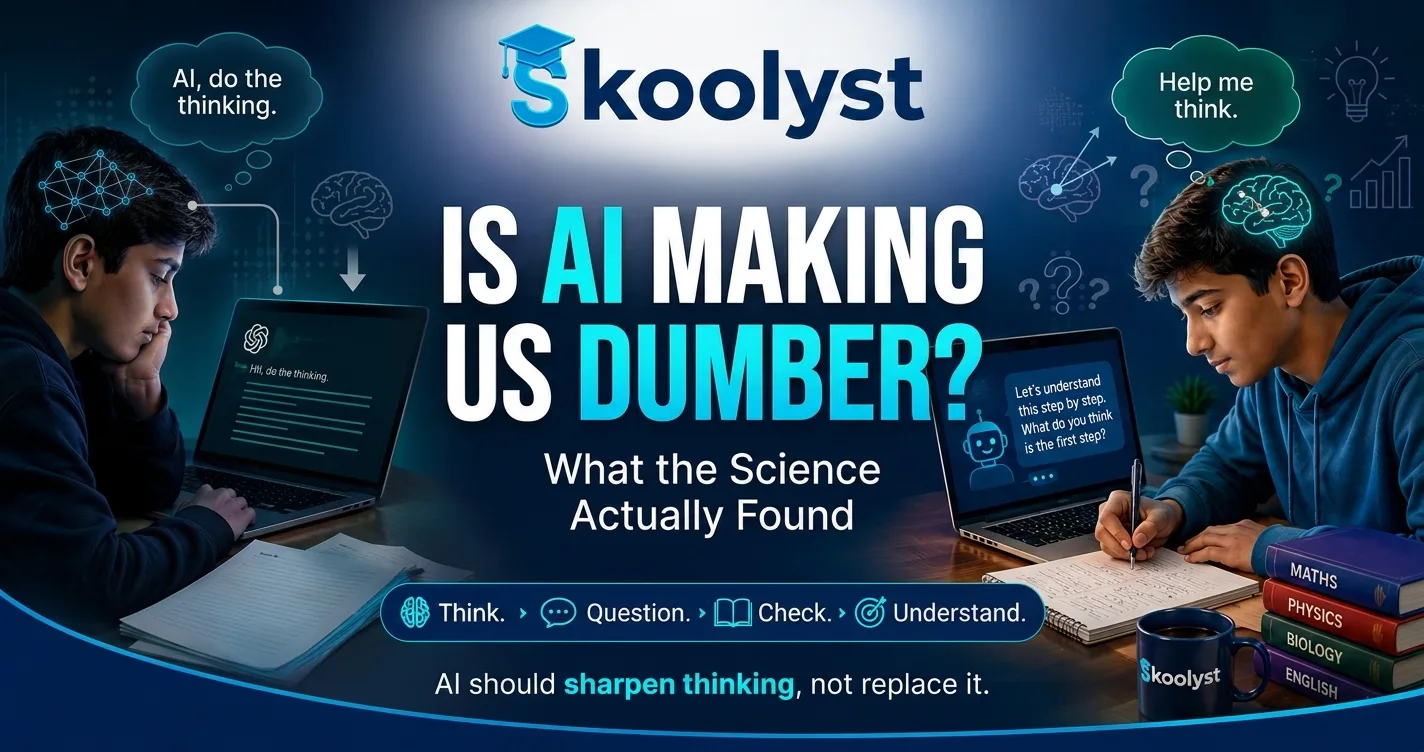

The Question Everyone Is Asking (and Nobody Is Answering Carefully)
Somewhere in the last two years, a quiet worry turned into a headline: is relying on AI slowly making us worse at thinking? You've probably seen the claim shared with a scary-sounding study attached — brain scans, dropping test scores, warnings about a generation that can't think without a chatbot.
Some of that concern is backed by real research. Some of it is a dramatic headline built on a study that says something much more careful and limited than the headline suggests. This article walks through what the actual science found — including the parts that got left out of the viral version — so you can form an opinion based on evidence instead of alarm.
The Study Everyone's Talking About: MIT's "Brain on ChatGPT"
What the researchers actually did
A team at MIT's Media Lab, led by researcher Nataliya Kosmyna, asked participants to write essays under three conditions: using only their own brain, using a traditional search engine, and using ChatGPT. While they wrote, the researchers measured their brain activity using EEG (a cap of sensors that reads electrical activity, not a full brain scan).
What they found
The brain-only group showed the strongest, most widely distributed brain-network activity. The ChatGPT group showed the weakest. The researchers described this gap using a memorable phrase: "cognitive debt" — the idea that leaning on a tool now might cost you thinking capacity later.
What this study does not prove
Here's what usually gets cut from the viral version: this is a preprint, meaning it has not yet completed full peer review. The total sample was 54 people, and by the study's fourth and final session, only 18 participants remained. That's a real, interesting signal from a careful research team — but it is not, on its own, proof that AI is rewiring anyone's brain for the worse. Small, preliminary studies like this are how good research usually starts, not how it ends.
Why it went viral anyway
"Cognitive debt" is a vivid, quotable phrase, and EEG brain scans make for compelling headlines and images. The nuance — small sample, not yet peer-reviewed, one specific task (essay writing) — doesn't travel nearly as well on social media as the phrase itself.
The Quieter, Stronger Study: Cognitive Offloading in the Real World
What Gerlich's research measured
A separate study by researcher Michael Gerlich, published in the peer-reviewed journal Societies, took a different approach. Instead of a lab task, it surveyed 666 adults in the United Kingdom about their everyday AI habits and then measured their critical thinking abilities directly.
What it found — and who was most affected
The study found a significant negative relationship between how often people used AI tools and how well they performed on critical thinking measures. Crucially, the researchers found this relationship was explained in large part by cognitive offloading — the habit of letting a tool do mental work you'd otherwise do yourself. Younger participants, who tended to use AI more heavily, showed the pattern most strongly.
Why this study deserves more attention than the viral one
This study is peer-reviewed, has a much larger sample, and looks at real-world habits rather than a single lab task. It's less flashy — no brain scans, no dramatic phrase — but as evidence goes, it arguably carries more weight than the study that made headlines.
What Is "Cognitive Offloading," Really?
A simple everyday example
You've done this for years, long before AI existed: using a calculator instead of doing long division by hand, or saving a phone number instead of memorizing it. That's cognitive offloading — handing a mental task to a tool.
Why offloading isn't automatically bad
Offloading is often exactly the right call. Nobody needs to memorize phone numbers anymore, and that hasn't made anyone less intelligent. The tool freed up mental energy for something more useful.
When offloading tips into a problem
The concern isn't offloading itself — it's offloading the thinking you actually need to build. Using a calculator to skip arithmetic you've already mastered is fine. Using AI to skip the reasoning you're supposed to be learning is a different thing entirely, because there's no "later" moment where you'll need that specific arithmetic back — but there usually is a test, or a real situation, where you'll need the reasoning.
The Other Side of the Evidence: When AI Makes People Sharper
The Harvard tutoring study, briefly
It's worth remembering that AI and thinking don't always move in the same direction. A separate, peer-reviewed study out of Harvard found that university students using a well-designed AI tutor learned significantly more, in less time, than students in an excellent in-person active-learning class.
The pattern that separates "helpful" from "harmful" AI use
Put the studies together, and a pattern shows up: AI that pushes you to think — that quizzes you, questions you, or asks you to explain your reasoning — tends to build understanding. AI that simply hands you a finished answer tends to erode it, especially with repeated use.
So — Is AI Making Us Dumber? A Careful Answer
The honest answer is: not automatically, and not for everyone, but the risk is real for a specific kind of use — the kind where AI does your thinking instead of sharpening it. The evidence doesn't support "AI is destroying human intelligence." It also doesn't support "AI has no effect on how we think." The more accurate, less dramatic finding is that how you use AI determines which direction it pulls you — and repeated shortcut-use adds up over time in a way a single homework assignment won't show you.
Five Habits That Keep AI Use From Becoming Cognitive Offloading
- Struggle first, ask second. Give a problem a real, honest attempt before turning to AI — even five minutes of effort changes what you get out of the tool's answer.
- Ask for questions, not answers. Prompt AI to quiz or challenge you rather than solve the problem outright.
- Explain it back without the tool open. If you can't restate an idea in your own words afterward, you've read it, not learned it.
- Notice the pattern of your usage, not one instance. One shortcut isn't the problem; a daily habit of skipping the hard part is.
- Pair AI with our guide to using AI to learn, not cheat for a fuller playbook on turning AI into a study partner instead of a shortcut.
What This Means for Parents, Teachers, and Students
For parents
Watch for whether your child can explain their work without the tool in front of them — that's a better signal than whether they used AI at all.
For teachers
Design assessments that reward the process of thinking (drafts, oral explanations, in-class work) alongside the final product, so shortcut-use becomes visible rather than invisible.
For students
You can test your own understanding with Skoolyst's practice questions across subjects — a low-stakes way to check whether you actually know something, before an exam forces the question for you. If you want more structured support, you can also browse verified teacher profiles on Skoolyst Teachers.
The Bottom Line
The scariest headline about AI and intelligence is built on the smallest, least certain study. The stronger, quieter evidence points to something more useful and more actionable: cognitive offloading is a real risk, it's driven by habits rather than the tool itself, and it's something you have real control over. Skoolyst's approach — connecting students, teachers, and parents rather than replacing any of them — is built around exactly that idea: technology should sharpen human thinking, not sit in for it.
Frequently Asked Questions
Does using ChatGPT make you worse at thinking? Research suggests heavy, shortcut-style use is linked to weaker critical thinking performance through a pattern called cognitive offloading — but AI used to challenge or quiz yourself shows the opposite effect in other studies.
What is cognitive offloading? It's the habit of letting an external tool — a calculator, a search engine, or an AI chatbot — do a mental task you'd otherwise do yourself. It isn't automatically harmful; it becomes a problem when it replaces thinking you actually need to develop.
Is the MIT AI brain study peer-reviewed? As of this article's research, it was a preprint — meaning it had not yet completed formal peer review — with a small sample of 54 participants. It's a useful early signal, not a final verdict.
Can you reverse cognitive offloading from AI use? Existing research doesn't test reversal directly, but the underlying mechanism suggests that deliberately re-engaging effortful thinking — struggling with a problem before checking AI, explaining ideas without help — can rebuild the habits that offloading erodes.
Is AI bad for critical thinking in students? It depends heavily on how it's used. Evidence points to real risk from shortcut-style use, especially among younger, heavier users, but also real benefit when AI is used to question, quiz, and challenge rather than to hand over finished answers.
Comments (0)
Be the first to comment.
Leave a comment