
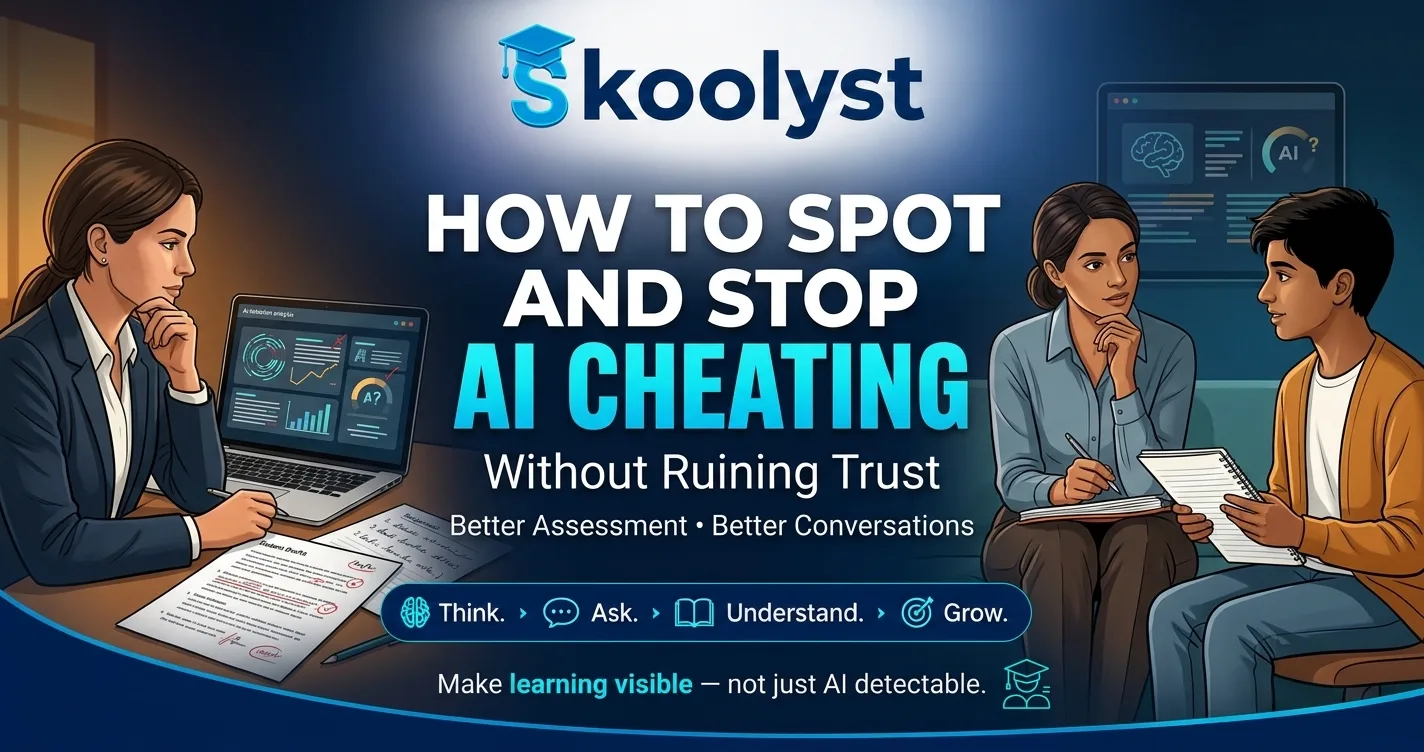

The Detection Trap Many Teachers Fall Into
A student turns in an essay that feels slightly off — too polished, oddly generic, missing the small imperfections you'd expect. The instinct is to run it through an AI-detection tool and treat the result as an answer. Increasingly, that instinct is leading teachers and institutions astray.
AI-detection tools are less reliable than most people assume, and a growing number of universities have stopped treating their output as proof of anything. This guide covers a more effective — and more trust-preserving — approach: reducing the opportunity and incentive to cheat through how assignments are designed, rather than trying to catch it after the fact.
Why AI Detection Tools Aren't the Answer
Why detection tools produce false positives
AI-detection software works by estimating the statistical likelihood that a text was AI-generated — not by definitively proving it. That means original, human-written work can be flagged incorrectly, particularly writing that's unusually formal, simple, or written by non-native English speakers, whose natural style can resemble patterns the tools associate with AI text.
Why universities are moving away from them
Reporting from Inside Higher Ed in August 2026 found that institutions including Yale, Vanderbilt, Johns Hopkins, and Indiana have moved away from relying on AI-detection tools as sole evidence of academic misconduct — a significant shift, given how widely these tools were adopted just a couple of years earlier.
The real-world stakes of getting it wrong
A false accusation of AI cheating can damage a student's trust in a teacher and in the fairness of the system itself — often more lasting damage than a single instance of unaddressed cheating would have caused. That asymmetry is part of why relying on detection tools alone is increasingly seen as a bigger institutional risk than it first appeared to be.
A Case Study: What Happened at UNAM
What triggered the retake
In 2026, Mexico's Universidad Nacional Autónoma de México (UNAM) ordered roughly 58,000 applicants to retake its first-ever online entrance exam in person, after the share of applicants scoring above 100 out of 120 points jumped from around 3.5% in the 2021–2025 period to 16% in 2026 — a shift university leadership viewed as a signal of widespread AI-assisted cheating on the online format.
What it reveals about detection at scale
UNAM's response wasn't built on a detection tool flagging individual students — it was based on an aggregate, statistical anomaly across the entire applicant pool. That distinction matters: catching a systemic problem through outcome patterns is a very different (and more defensible) approach than accusing individual students based on an unreliable per-submission detection score.
The Better Approach: Design Assignments AI Can't Easily Shortcut
Process over product
Grading drafts, outlines, and revision history alongside a final submission makes it far harder for AI-generated work to pass as a student's own — and reveals genuine growth in a way a single final document never can. This connects directly to what the research on AI's crutch effect shows: skills that look solid in a finished product can be entirely absent once you look at the process behind it.
In-class and oral components
A short in-class writing sample or a brief oral explanation of a submitted assignment reveals understanding — or its absence — far more reliably than any detection software.
Personalized and localized prompts
Assignments tied to a specific, recent classroom discussion, a local example, or a student's own stated experience are considerably harder for a generic AI tool to produce convincingly than broad, generic prompts.
What to Do When You Genuinely Suspect Cheating
Gather more than one signal
Treat a detection-tool score, if used at all, as one weak signal among several — inconsistent writing quality between class work and submitted work, an inability to discuss the content, or a sudden shift in vocabulary are more meaningful together than any single score alone.
Start the conversation with curiosity, not accusation
Open with "walk me through how you approached this" rather than "did you use AI to cheat." It invites an honest account rather than a defensive denial, and it doesn't presume guilt before you have real information. If a parent gets involved, our guide for parents navigating this at home covers the same conversation from their side, which can help keep the two conversations aligned.
What a fair conversation sounds like
A fair process focuses on whether the student can demonstrate understanding of their own submitted work, rather than resting entirely on a detection tool's percentage score — which, as outlined above, isn't reliable enough to serve as sole evidence on its own.
Building an AI Policy Students Will Actually Follow
Be specific, not vague
"No AI allowed" is hard to enforce and easy to misunderstand. "AI may be used for brainstorming and grammar checking, not for generating final text" gives students an actual standard to follow.
Make disclosure easy and low-stakes
A simple, required disclosure line — noting how AI was used, if at all — normalizes honesty and gives you far more useful information than a policy built entirely around catching violations after the fact. Our guide to using AI to learn, not cheat lays out this same disclosure-friendly framework from the student's side, which can help reinforce consistent expectations between classroom and home.
Revisit the policy as tools change
AI tools and their capabilities are changing quickly enough that a policy written a year ago may already be outdated — plan to revisit and update your policy each term rather than treating it as fixed.
What This Looks Like Across Different Subjects
- Writing/English: in-class drafting time, peer-review discussion, and short oral defenses of key arguments
- Math/Science: requiring shown work and brief verbal walkthroughs of problem-solving steps, not just final answers
- History/Social Studies: prompts tied to specific, recent class discussions or local context that a generic AI response wouldn't capture well
- Foreign Languages: spoken assessment components that are difficult to substitute with AI-generated written text
The Bottom Line
Chasing AI cheating with detection software puts teachers in an arms race they're likely to keep losing, while risking real harm to honest students caught by an unreliable false positive. The more durable approach is quieter and less dramatic: design assignments and classroom habits that make genuine understanding visible, and treat suspected cheating as a conversation to have carefully, not a verdict to hand down based on a percentage score. Skoolyst Teachers exists to help connect educators building exactly this kind of thoughtful, evidence-based classroom practice with schools and families who value it.
Frequently Asked Questions
How can teachers tell if a student used AI to cheat? No single signal is reliable on its own. Look for a combination of factors — inconsistency between a student's in-class work and submitted work, inability to explain their own submission, or unusual shifts in writing style — rather than relying on any single detection tool's score.
Are AI detection tools reliable? Not fully. They estimate likelihood rather than proving AI use definitively, and can produce false positives, particularly for non-native English speakers and unusually formal writing styles — which is part of why a growing number of universities no longer treat them as sole evidence of misconduct.
How do I create an AI policy for my classroom? Be specific about what is and isn't allowed for each type of assignment, build in an easy, low-stakes way for students to disclose AI use, and plan to revisit the policy regularly as AI tools continue to change.
What assignments are hardest for students to cheat on with AI? Assignments that require in-class writing, oral explanation, or reference to specific recent classroom discussions are considerably harder to complete convincingly using a generic AI tool.
How do universities handle AI cheating cases? Approaches vary, but a growing number of universities — including several highlighted in 2026 reporting — no longer rely on AI-detection software as sole evidence, instead combining multiple signals and giving students a chance to explain their work.


Comments (0)
Be the first to comment.
Leave a comment